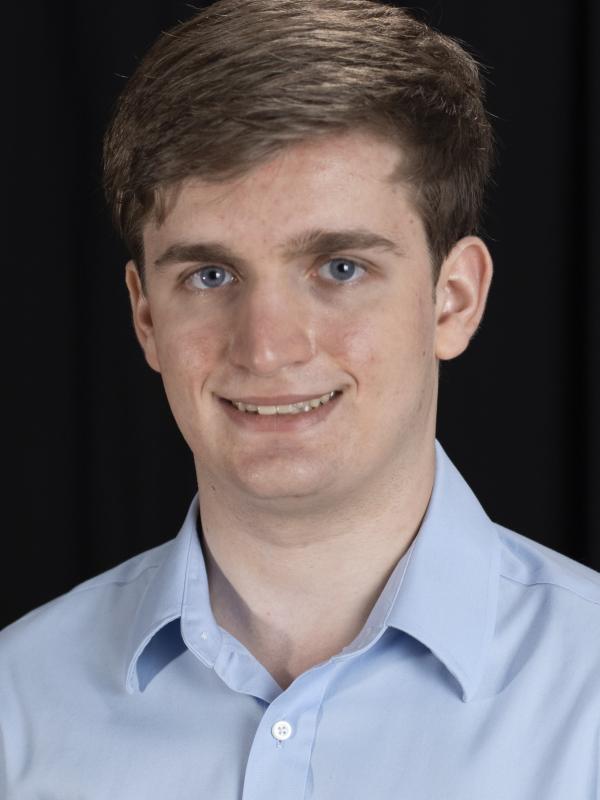
Torey Hilbert’s research portfolio
Hello humans! I am a 6th year PhD student in Statistics at Ohio State University, working with Steven MacEachern and Yuan Zhang. I will be searching for a postdoctoal position for the academic year 2027-2028; please feel free to reach out!
Broadly, I am interested in understanding the detailed behavior of estimators, and in particular understanding implicit assumptions of commonly used models. For example, I found that using kernel density estimation as a prediction rule in Bayesian predictive inference is analogous to a using a conditionally iid model that is compactly supported with probability one. This suggests that kernel density estimators are implicitly placing sharp assumptions on the tail decay, more than many analysts may suspect. Recently, my main project is on understanding how non-exchangeable predictive models, for example prediction via kernel density estimates, can be re-indexed to create exchangeable models.
I work on applications in biology and multiomics, and I particularly enjoy looking for theoretical properties of models that do not match observed data. I am grateful to work with Zakee Sabree at University of Toronto, integrating imaging data with multiomics data for gnotobiotic cockroaches.
Representative papers
Working papers
Hilbert & MacEachern (2026+)
Constructing exchangeable distributions via re-indexing predictive distributions in Bayesian inference
Preprints
Hilbert (2026+)
Predictive inference via kernel density estimates
[arxiv]
Peer-reviewed papers
Hilbert, MacEachern & Zhang (2026)
Robust distribution-free tests for the linear model
[Statistics in Medicine] [arxiv] [code]
Mentoring
I am passionate about improving access to research-style mathematics and statistics. I am the vice-chair of the Math Cycle program together with Kacey Aurum. In this program, we form small groups of undergraduate students to work on a one year research project mentored by a PhD student. This gives graduate students interested in an academic career experience advising students, and helps expose undergraduate students to the different type of thinking and puzzles involved with doing math research.
Throughout the past three years, I have mentored undergraduate research projects on: computer vision for American sign language; Langevin algorithms for posterior sampling; spatial modeling for MODIS vegatation data; theoretical foundations for geometric deep learning; and diffusion on manifolds. Last year, we had over 70 participants in the program, and over 100 people attending the Cycle conference for undergraduate research. If you are interested in learning more about this program, either as a student, a potential mentor, or someone looking to set up a similar program at your own university, please feel free to reach out to me!